Exploring Arouca Geopark: Nature, Heritage & Beyond
Most travelers head straight to the wooden river boardwalks and call it a day. That is a mistake. Covering roughly 328 square kilometers of craggy mountains, deep valleys, and forgotten slate hamlets in northern Portugal, the arouca geopark holds 41 classified geosites recognized by UNESCO. It is rugged country, carved open by the Paiva and Caima rivers, where granite plateaus plunge into cloud-filled gorges. You can stand on a wind-scoured ridge watching golden eagles circle, then descend twenty minutes later into a sheltered river valley smelling of wild mint and eucalyptus.
I spent five days wandering these backroads with a crumpled map and muddy hiking boots. Between slate villages tucked into fold after fold of the Serra da Freita and prehistoric oddities that exist nowhere else on the planet, this corner of the country rewards anyone willing to stray beyond the main tourist corridors. Here is what makes this territory special, from giant sea bugs turned to stone to plateaus where rocks mysteriously give birth.
Book your paiva walkways experience:
Geological Oddities Inside Arouca Geopark
Geology sounds dry until you see rocks doing things that defy common sense. In the village of Castanheira, high up on the granite spine of Serra da Freita, you run into the Pedras Parideiras. The name translates literally to "the stones that give birth." A granite outcrop over thousands of years develops dark, rounded nodules of biotite mica. Due to temperature swings and mechanical erosion, the granite casing splits, and the rock literally sheds these flat, disk-shaped baby stones onto the ground. Locals used to keep them under pillows for fertility, and shepherds swore they brought luck during lightning storms.
Note: Taking a birthing stone home is strictly illegal and carries heavy fines from park wardens. Admire them in the granite bed at the interpretive center, take your photos, and leave the pebbles where they drop.
A short drive west brings you to Canelas. It feels like an ordinary quiet hamlet until you walk into the slate quarry museum run by Manuel Valério. Back in the late 1990s, workers quarrying slate for building tiles began uncovering trilobites. Not the coin-sized fossils found in school classrooms, but monstrous, armored arthropods that crawled along shallow ocean floors 465 million years ago. Some specimens measure nearly 90 centimeters long, making them the largest fossilized trilobites anywhere on Earth.
Then there is Frecha da Mizarela. The Caima River gathers momentum on the high plateau and suddenly drops over a sheer wall of granite. It falls more than 75 meters into an amphitheater of boulders and moss. If you arrive early before the mist burns away, the roar echoes through the gorge while the water disappears into white vapor before it even hits the bottom pool.
Hiking the Arouca Geopark Paiva Walkways and Beyond
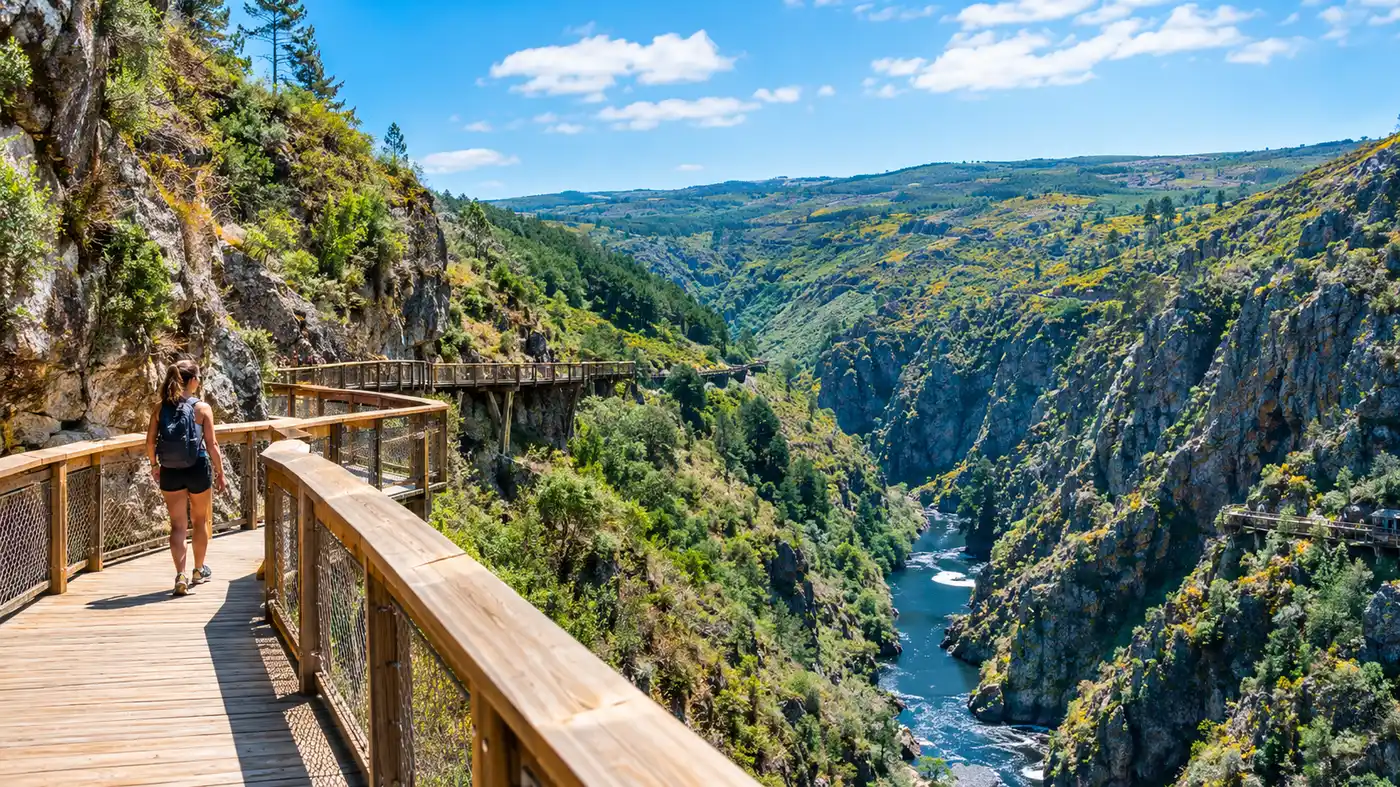
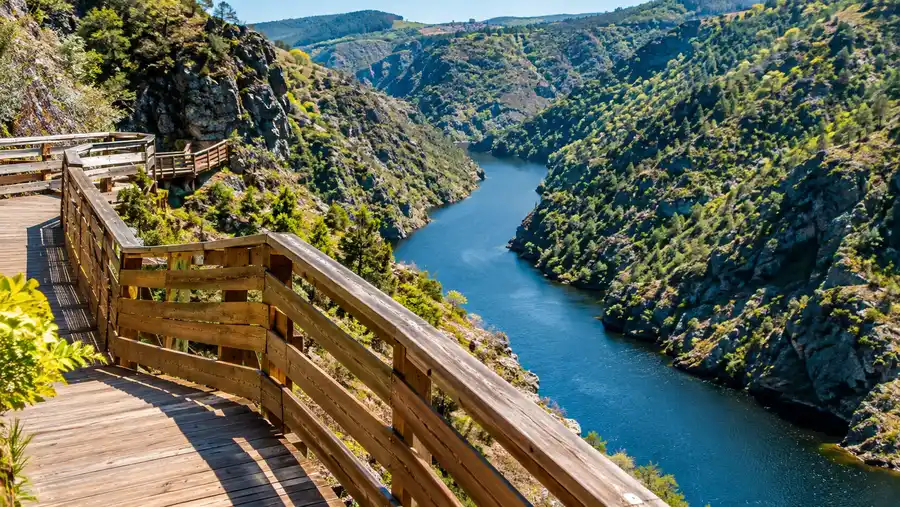
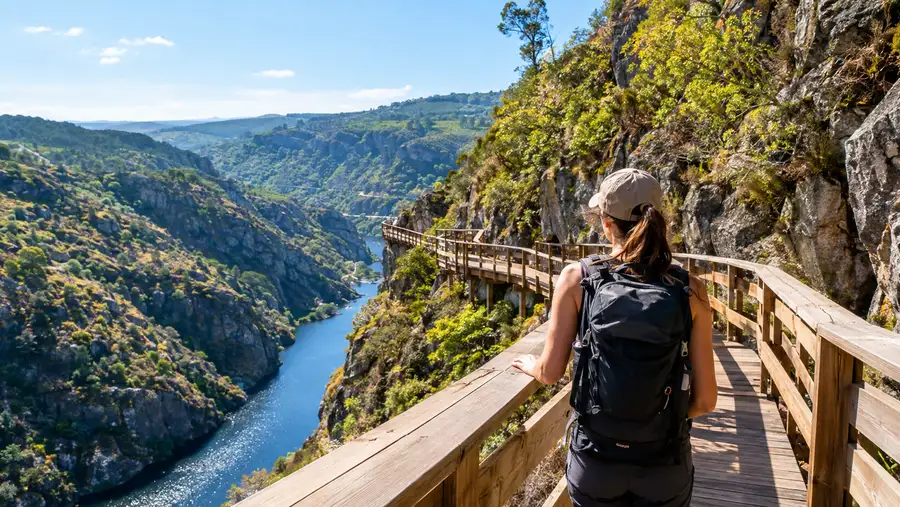
Down in the Paiva valley, the terrain turns vertical. The river punches through narrow quartzite gorges, creating wild Class IV rapids that kayak guides whisper about with reverence. This gorge is where the world-famous wooden path clings to cliff walls. The eight-kilometer route known as the arouca geopark paiva walkways snakes along the left bank from Areinho to Espiunca, giving you front-row seats to plunging drops and turquoise pools.
Suspended high above the river gorge hangs the monster pedestrian bridge. Crossing the wire-mesh floor on the 516 Arouca suspension bridge will make your calves tremble, especially on windy afternoons when the valley air funnels beneath your boots. Looking straight down into the canyon from 175 meters up gives you a dizzying perspective on how deep the river has carved into the granite rock face.
Because the gorge forms an administrative boundary, many visitors search for the paiva walkways aveiro portugal connection, unaware that the trail rests inside the municipal borders of Arouca while sitting within the broader Aveiro district. Starting near the village of Alvarenga brings you directly to the highest cliffs. The pairing of the paiva walkways and alvarenga works nicely because you can finish a long morning trek and sit down immediately to hot, smoky chouriço and local bread at the trailhead taverns.
Pro tip: If hiking between Areinho and Espiunca, start at Areinho. That way you tackle the brutal staircase of 400 vertical steps right at the beginning while your legs are fresh, leaving the remaining six kilometers as a gentle downhill stroll along the riverbed.
Most visitors stick purely to the boardwalk path, known locally as the paiva walkways parque de arouca. That leaves miles of empty backcountry trails untouched. High above the river, the PR15 trail traces old goat tracks along the ridges, offering panorama views of the entire Paiva canyon without another soul in sight. The geology underfoot shifts rapidly from hard granite to black slate, telling stories of ancient continental collisions that occurred long before humans walked these ridges.
| Geosite Name | Feature Type | Elevation / Setting | Key Highlight |
|---|---|---|---|
| Pedras Parideiras | Geological curiosity | 950m, mountain plateau | Granite boulders shedding mica nodules |
| Canelas Slate Quarry | Paleontology | 420m, valley facility | World record giant trilobite fossils |
| Frecha da Mizarela | Hydrological / Waterfall | 920m, river edge | 75m waterfall over granite cliff |
| Paiva River Gorge | Geomorphology / Fluvial | 160m, steep canyon | Quartzite canyon crossed by wooden trail |
| Pedra Posta | Granite weathering | 1,000m, exposed ridge | Enormous boulder balancing on bedrock |
Traditional Villages and Mountain Culture in Arouca Portugal
Life in the mountains of arouca portugal runs on a different clock. Cattle with huge, lyre-shaped horns roam freely along the tarmac roads of the Serra da Freita. These are Arouquesa cows, an ancient heritage breed perfectly adapted to the steep slopes and prickly gorse bushes. You have to slow your car down to five kilometers an hour and wait as a herd of twelve slowly ambles past your front bumper, their copper bells clanking softly in the fog.
Tucked into a steep, forgotten fold of the mountains lies Drave. No paved road reaches it. To get there, you park near the mining ruins of Regoufe and hike four kilometers along a rocky track lined with dry stone walls. Drave has no permanent residents left, no mains water, and no electrical grid. The houses are built entirely of dark slate, their slab roofs overlapping like fish scales. Wild blackberry bushes crawl over broken doorways, and a crystal-clear mountain brook pools below an old stone bridge. The silence in the valley is absolute.
Other mountain settlements tell similar stories of survival against thin soil and bitter winter winds. Walking through these hamlets reveals how people lived here for generations without machinery:
- Paradinha: Clustered on a steep riverbank, full of restored schist cottages and fig trees leaning over stone pathways.
- Regoufe: Famous for abandoned British and German tungsten mines that operated side by side during World War II.
- Tabaçô: A tiny farming settlement surrounded by terraced cornfields cut directly into the mountain slopes.
- Cabreiros: Perched near the highest pass, where stone houses huddle close together to break the Atlantic gales.
In Paradinha, the Paiva river widens out, running slow and clear across smooth river stones. You can sit on a granite boulder under the shade of an alder tree and dip your toes into cold water that fell as rain on the high plateau three hours earlier. It feels miles away from the modern world.
Book your paiva walkways experience:
Monasteries and Local Flavors of Portugal Arouca
Before you climb into the hills, spend an hour in the valley floor. The town center of portugal arouca grew up entirely around the imposing walls of the Real Mosteiro de Santa Maria de Arouca. Founded in the 10th century and later taken over by the Cistercian order, this convent once held immense wealth and political power across northern Portugal. Queen Mafalda, daughter of King Sancho I, lived here as a nun in the 1200s, pouring her royal fortune into expanding the cloisters and chapels.
The nuns may have spent hours in silent prayer, but they were wizards in the kitchen. When monastic orders dissolved in the 19th century, their culinary secrets spilled out into the village bakeries. You cannot leave the town without trying the conventual sweets. Eggs, sugar, and almonds form the holy trinity of Arouca pastries. Walk into any pastry shop along the main square and ask for castanhas doces (sweet chestnuts made of almond paste) or barrigas de freira, which translates amusingly to "nuns' bellies."
Dinner calls for something hearty after hiking through mountain passes. The local specialty is vitela arouquesa assada no forno, tender veal roasted for hours in traditional wood-fired earthenware pots until the meat collapses off the bone at the touch of a fork. Pair it with a cold glass of crisp green wine produced along the lower terraces near the river, followed by a slice of sheep's milk cheese aged with thistle flower.
Practical Advice for Visiting Arouca Geopark
Getting around requires planning because public transit across the geopark is almost nonexistent. A car gives you the freedom to climb from the river floor up to the 1,000-meter plateau whenever rain clouds lift. If you are debating routes and transfers, read through how to get to Paiva Walkways to get your logistics sorted before arriving.
Weather on the plateau catches many people unprepared. You can leave Porto under blue skies with temperatures hovering around 24 degrees Celsius, only to find the high ridges of Serra da Freita wrapped in thick, freezing fog with visibility under ten meters. Pack layers in your trunk even in July. Good boots are mandatory because the granite rocks on the trails turn slick as soap when wet.
To get the most out of your time exploring, keep these practical points in mind:
- Fuel up early: Gas stations are scarce once you leave the main town of Arouca, so fill your tank before heading into the hills.
- Carry cash: Small village cafes in places like Regoufe or Castanheira rarely accept foreign cards for small purchases.
- Download offline maps: Cell phone reception drops out completely in the deeper gorges and around the Drave trail.
- Watch for cattle: Drive cautiously around blind corners on mountain roads where Arouquesa cows rest directly on the asphalt.
- Time your meals: Rural restaurants stop serving lunch strictly at 3:00 PM, and finding food in small villages mid-afternoon is nearly impossible.
Combining the dramatic river scenery of the paiva walkways and aveiro region with the lonely heights of the Freita plateau takes roughly two full days. Sleep in a restored granite cottage in one of the mountain hamlets if you can find one open. Waking up to sheep bells and mountain mist drifting through slate chimneys beats any generic city hotel.
Frequently Asked Questions about arouca geopark
How many days do you need to see Arouca Geopark?
Two full days are ideal. Spend one full day hiking the Paiva river canyon and crossing the suspension bridge, and dedicate your second day to exploring the high plateau, the birthing stones, the Canelas fossil museum, and remote villages like Drave.
Can you visit the geopark without a car?
It is difficult. While organized day tours run from Porto to the Paiva Walkways, reaching the geological sites on the high plateau and the slate villages without your own vehicle or a private hired driver is nearly impossible due to the lack of regional bus routes.
Is Arouca Geopark suitable for children?
Yes, but choose your activities carefully. The Canelas trilobite museum and the interactive Casa das Pedras Parideiras are fantastic for kids. The main river boardwalk is safe with guardrails, though the long staircase at Areinho can exhaust smaller children.
Quick Reference
- Location: Aveiro District, Northern Portugal
- UNESCO Recognition: Awarded in 2009
- Total Geosites: 41 documented sites
- Key Attractions: 516 Bridge, Mizarela Fall, Drave village
- Best Time: April to June and September to October
Book your paiva walkways experience:
Before You Go
There is a raw, untamed quality to this landscape that stays with you long after you shake the red dust off your boots. Take your time winding along the hairpins of the Serra da Freita, strike up a conversation with the tavern owners over a plate of roasted veal, and look closely at the rocks beneath your feet. You might just be walking on top of half a billion years of forgotten history.
Read more about paiva walkways.